Product designer & builder
I find the one thing worth building.
Then I build it.
Most people hiring for this are picking between a strategist who cannot build and a builder with no taste. I am both. Twenty years of product judgment, and working software in front of real users in weeks.
Most projects do not fail on execution. They fail because everything looked equally important on day one. I find the one thing that has to be true, and tell you what to cut.

Selected work
A claim, and the proof of the claim
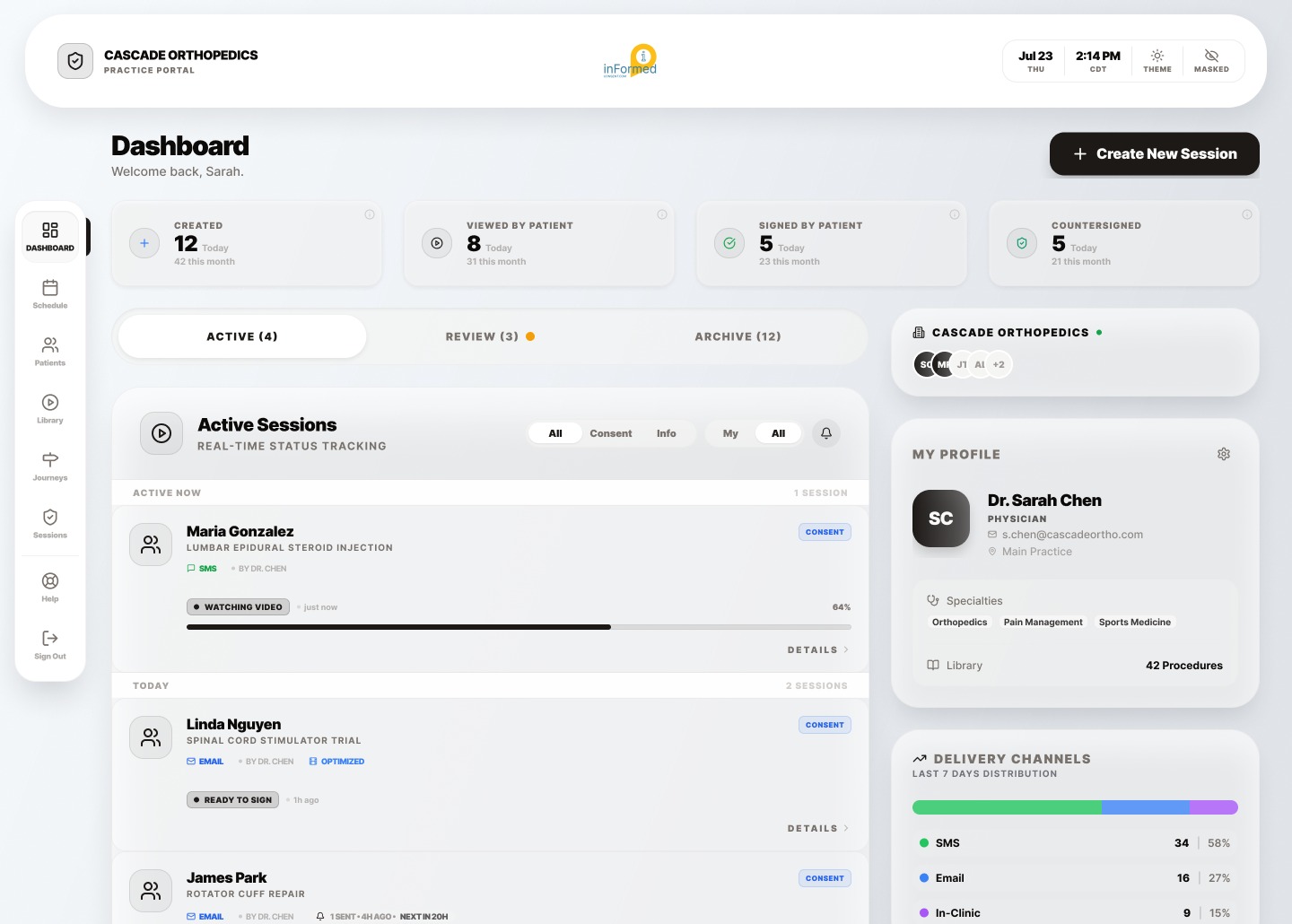
inFormed Consent
A patented platform that turns informed consent from a signature into something a patient actually understands. I built the technology from nothing: personalized AI avatars, video-tracked comprehension, live with clinicians.
What a doctor has to disclose
A research agent reads the literature. A clinician signs what a patient will hear. The system in between, and why the hard part was deciding what a risk list even is.
The consent session
It records you, watches whether you are looking, and will not let you skip. Every one of those is a legal necessity and a reason to distrust the screen. Making the enforcement legible instead of sneaky.
The consent that never recorded
Recordings started going missing and most of them could not say why. Separating a telemetry gap from a real defect, and a failure vocabulary that names what it costs the patient.
Playfair Data
Where the work bent hard toward data. Not prettier dashboards. Clearer ones, more usable, more scalable, built as products rather than one-offs. I hired and led the UX team, and built the internal design system that let the work scale past what any one designer could hold in their head.
The Overdose Epidemic
A public data dashboard for the American Medical Association. I started with listening sessions with AMA leadership to find the argument, wrote the hypotheses and interview questions to sharpen it, then defined the data schema where the raw data would not carry it. Opioid prescriptions down 49 percent while overdoses kept climbing, made arguable rather than just visible.
Data + Design
Dashboards leaders actually use, and the invented Leapfrog Chart for a Fortune 10 client. Turning complex data into a decision someone can make.
FIVE
A strategic product design firm founded by people who had run product teams from the inside rather than from an agency. The house method was systems thinking, which they described as traversing abstraction: break a problem into its parts, move up and down the levels, and generate the context that makes a decision possible. I ran user experience strategy. The work went from coral reef science to youth sports to hotel supply chains, which sounds scattered and was not.
Coral Resilience Data Platform
Collect, analyse and visualise coral reef health for researchers, conservationists and policymakers. I interviewed five domain experts across four countries and plotted each on a context ladder, because a policymaker and a field inspector need the same data at different resolutions. That shape drove the dashboard.
MindClick
A supplier sustainability rating for a global hospitality brand. Facility emissions measured against a baseline year, facility environmental and labour commitments, and product scoring across nine dimensions, joined into one grade a buyer can act on in a single page.
Step Up Your Game
Wireframing a one-stop platform that gives young athletes a high athletic IQ, combining physical therapists, dietitians, and coaches into one guided experience.
JP Creative
My own practice, and the stretch that looks like wandering on paper. Different sectors, different problem types, same job every time: walk into a messy system and make it understandable enough that someone can act. Research and facilitation at the front, wireframes and prototypes in the middle, and enough technical judgment to know what was actually buildable.
Youth as Experts
For the Kauffman Foundation and Kansas City Public Library. Design-thinking workshops where the teenagers were the experts and I was the facilitator, then the clickable prototype their own ideas asked for, and the insights report that went in for funding.
Youth Entrepreneurship
Back at the Kauffman Foundation a year later. Six months of landscape research, then a concept-pitch exercise with a cross-programme committee. Halfway through summarising the pitches I cut the planned vote, because the eight of them were describing one strategy, not eight.
Hallmark Cards
Where creative work became intellectual property. I came up through photo shoots and physical product, then moved into innovation and learned that an idea can become a product, a patent, and a line of revenue, and that the distance between those three is mostly nerve. Teams up to forty people, and a lot of things you could hold in your hand.
Six patents
Light and shadow projection. Real-time sound. A fill-in-the-blank audio story engine. A holiday toy microphone. Three issued, three filed.
The rest of it
A few things that are also true
I teach
At Guang Ming Temple in Orlando I taught Buddhist philosophy, including a class called Visualizing Buddhism that merged data visualization with the Dharma. Take something complex, make it clear enough to hold. Same instinct as the day job. RYT 200, so the line about flexibility of body and mind is a practice, not a metaphor.
I make things with my hands
3D printers and scanners, a laser cutter, a CNC mill, Arduino, soldering, vacuum forming, sculpting, sewing. Solidworks and Rhino. I am suspicious of anyone who designs objects and has never ruined one.
I turned down the developer’s chair
Around 2000, at a dot-com called eScout, I taught myself to hand-code the web before the tools existed and learned to ssh into production. They offered me a job as a developer. I said no. I did not want to stop being the person who decides what gets built. Twenty-five years later that is still the whole job description.
I started over
Four years ago I walked away from most of it. A marriage of twenty-five years. A career. A whole identity. I became a startup CTO on the other side of it. It cost me things I am not getting back, and I would still do it. I do not say that to be inspiring. I say it because most of the people I work with are sitting on something they are scared to start.
Tell me what you are building
I read every one of these. If it is a fit I will tell you what I would build first, before you have paid me anything. If it is not, I will tell you that too.
Start the conversation